Faster development of better powder nozzles for laser deposition processes (laser cladding, direct metal deposition, …)
- Too much oxidation?
- Spatter/sparks damaging optics?
- Other issues?
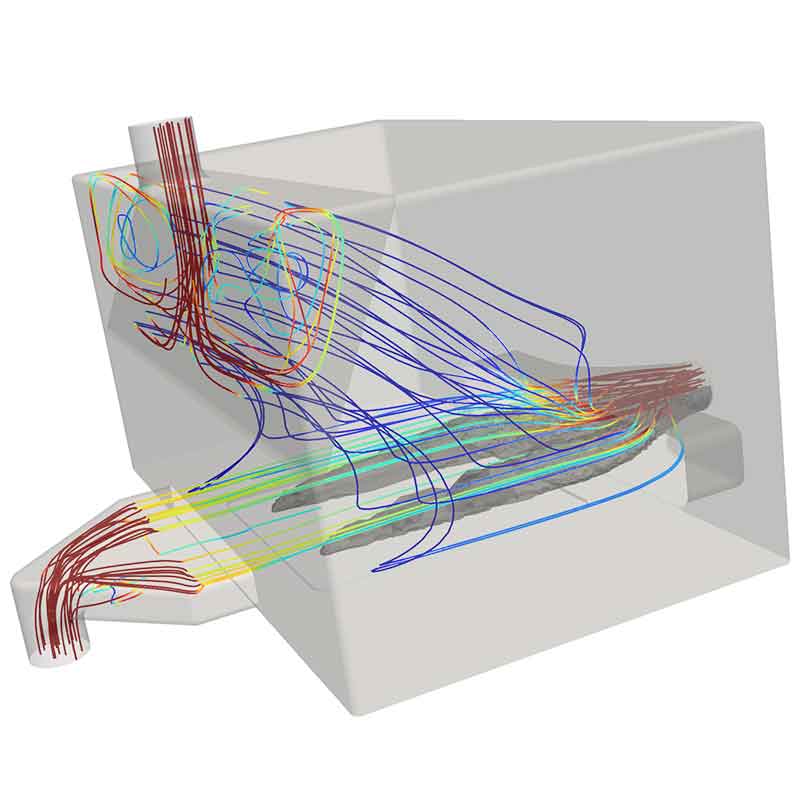
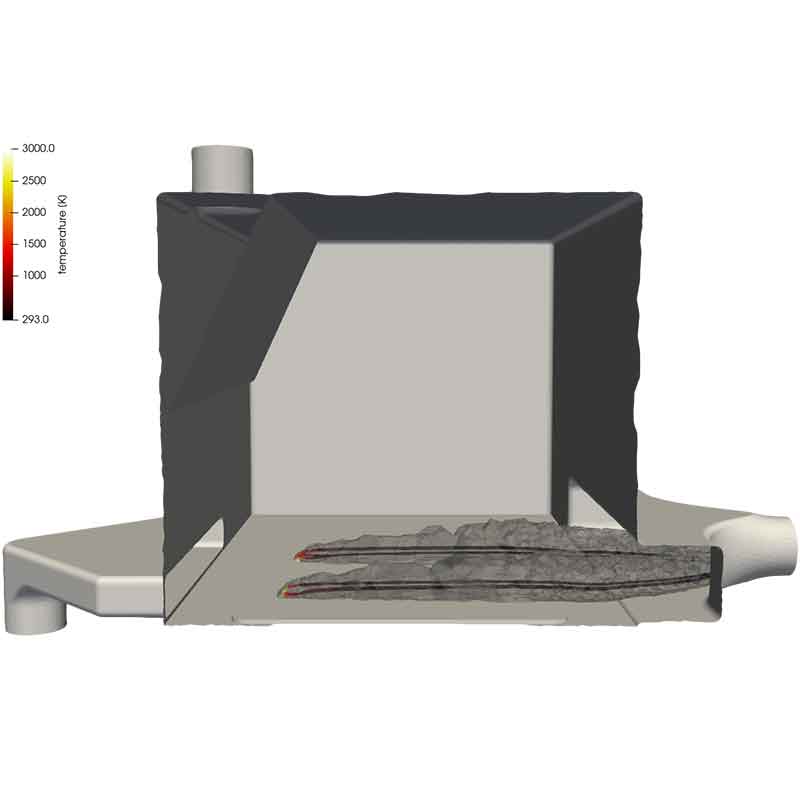
There is a vast variety of application- and process-specific parameters in laser cladding processes (powder nozzle type, gas types, gas volume flow rates, powder feed rate, conventional vs. high-speed laser cladding, spatial accessibility, …). Therefore, there are only few standard solutions. Simulation is a powerful tool to optimize the design of a specific powder nozzle and the parameters such as gas type and volume flow rate. Moreover, concepts such as a cross-jet can be examined, that shall keep spatter, sparks etc. away from optical components without impairing the process.
Main kinds of powder nozzles
There are basically three main kinds of powder nozzles. While an off-axis powder nozzle delivers powder only from one side into the melt pool, a discontinuous coaxial powder nozzle provides three or even more powder jets aiming at the melt pool from circumferentially evenly distributed directions. A continuous coaxial powder nozzle shows an annular gap, where powder leaves the nozzle focused on the melt pool. The latter powder nozzle design facilitates a small powder jet diameter in the working plane and so a high powder deposition efficiency. But the maximum possible powder feed rate is lower compared to a discontinuous coaxial powder nozzle and the 3D capability of the powder nozzle is limited, because the powder can accumulate on one side inside the nozzle due to gravity when the nozzle is tilted.
There are also powder nozzles for inner diameter laser cladding, where limited space puts an extra challenge to the design of the nozzle.
Conventional vs. high-speed laser cladding
There are many requirements a powder nozzle must fulfill. Depending on the desired process regime, it must guarantee a sufficient interaction time between the laser beam and the powder particles during their flight. In conventional laser cladding, the particles arrive at the melt pool in a solid state and are melted inside the melt pool. In contrast, high-speed laser cladding or extreme high-speed laser cladding (EHLA) requires the melting of the particles before arriving at the melt pool. Therefore, the powder particle velocity and the powder jet focus have to be adapted accordingly.
Oxidation
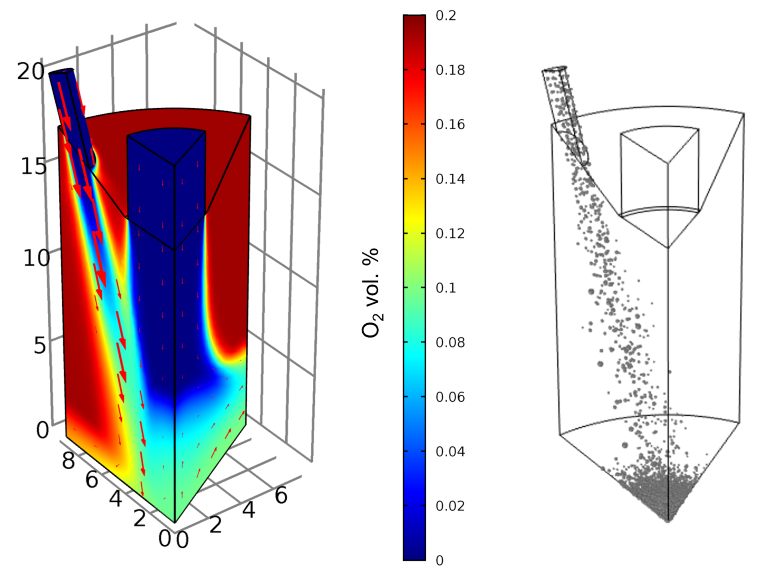
The process gases coming out of the nozzle shall protect the melt pool from oxidation. The quality of the shielding gas atmosphere depends on the gas flow rate, gas types and nozzle geometry. With an optimized setup, it is possible to achieve an oxygen percentage that is as low as in a chamber filled with inert gas and allows the processing of titanium. Argon is the most popular gas in industry due to its high density so that it stays at the bottom and covers the melt pool. For the sake of simplicity, and as it’s cheaper than helium, it is often used not only as the shielding gas but also as the carrier gas. However, in the case of off-axis or discontinuous powder nozzles, an argon carrier gas jet drags oxygen from outside into the inert gas atmosphere above the melt pool. Here, helium with its low density is an advantageous carrier gas. The disadvantage of argon can only be reduced by a proper nozzle design. Though, this reduction is limited by the desired powder mass flow rate and maximum powder focus diameter. Some publications generally claim that helium impairs the inert gas atmosphere above the melt pool. But this is only true for certain cases such as continuous coaxial nozzles with an additional shaping gas for example. Finally, nitrogen must be named as a cheap process gas that can be used when the processed material is not too sensitive to oxidation and when nitrogen doesn’t impair the microstructure of the deposited material.
Protection of optical components from spatter, soot etc.
In an industrial environment where a process must work reliably for many hours, a powder nozzle must meet additional requirements. If optical elements such as a protective glass are contaminated by spatter, unmelted glowing powder particles or soot, the game-over for equipment and process can occur quickly. A tilted powder nozzle, where the laser beam and powder jet are not perpendicular to the processed surface, can help, but this is not the final solution. Cross jets are well known to protect the optics in laser cutting and deep penetration welding processes from spatter. However, in the case of laser cladding it must be ensured that the cross jet does not impair the powder jet, the inert gas atmosphere above the melt pool or the melt pool itself.
Simulation
In any case, simulation is a powerful tool verify/dimension/optimize the design of a specific powder nozzle and the parameters such as gas type and volume flow rate. It shows the concentration of the involved gases, the powder (and spatter!) particle trajectories, gas flow velocities und much more. Please get in touch if you have questions regarding the capabilities of a simulation or if you face a challenge where we could help!